+44 (0)1482 770583
 hello@systechitsolutions.co.uk
Part 5 of 13 in Meeting the DfE digital and technology standards.
You have a broadband contract, it mostly works, and a governor has just asked whether it meets the DfE standard. For many schools the honest answer is "we are not sure", because nobody has read the contract against the wording.
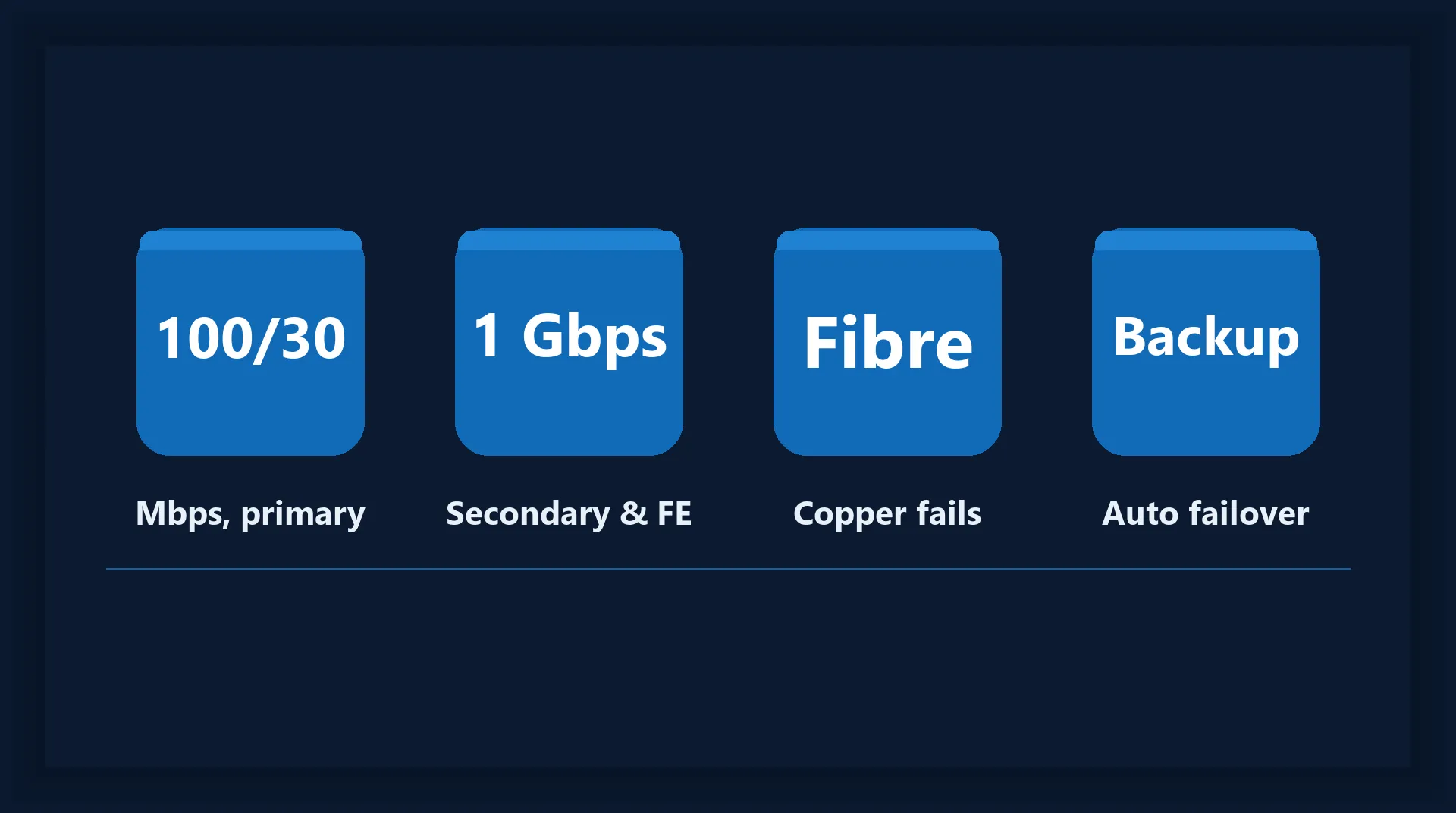
In short: The DfE broadband internet standard is one of the six core standards schools and colleges should be working towards meeting by 2030. It asks for three things: a full fibre connection at the right speed (a minimum of 100Mbps download and 30Mbps upload for a primary, capacity for 1Gbps download and upload for secondaries, all-through schools and FE colleges), a backup connection with automatic failover, and filtering plus a firewall as part of the connection. Copper connections do not meet it. The first step is to find your contract and check three lines: the connection type, the contracted speeds, and what happens when the line fails.
What does the standard actually ask for?
The broadband internet core standard is short. The DfE's strapline is "get the right connection type and speed for your school or college, and a backup connection to ensure resilience and appropriate safeguarding systems". It breaks into three requirements, in the DfE's own words and order:
- "Schools and colleges should use a full fibre connection for their broadband service"
- "Schools and colleges should have a backup broadband connection to ensure resilience and maintain continuity of service"
- "Schools and colleges should have appropriate IT security and safeguarding systems in place, under both child and data protection legislation"
The first two carry the 2030 horizon that applies to all six core standards, which we set out in our guide to the DfE digital standards. The third is different. The DfE says you should already be meeting it as part of your ongoing safeguarding requirements. Keep that distinction in mind, because it changes what you tell governors about each one.
Are you on full fibre, and is it fast enough?
The DfE's reason for full fibre is that "full fibre services provide the capacity and speed needed for effective use of online learning tools". The speeds it sets depend on the phase of the school.
- Primary schools: "a minimum of 100Mbps download speed and a minimum of 30Mbps upload speed".
- Secondary schools, all-through schools and further education colleges: "a connection with the capacity to deliver 1Gbps download and upload speed".
- Connection type, every phase: "Broadband should be provided using a full fibre connection." The DfE notes this is sometimes described as a leased line or fibre to the premises (FTTP), and states that "copper connections do not meet this standard".
Two things trip schools up here. The first is upload. Most broadband is sold on its download figure, but the DfE sets both, and the secondary figure is symmetrical. Cloud platforms, video calls and backups all push data out of the building, so a fast download on a slow upload is not a match.
The second is the word "fibre". A service marketed as fibre broadband that arrives over a copper line for the final stretch from the street cabinet is, in practical terms, a copper connection. The only way to be certain is to ask the supplier in writing whether the circuit is a leased line or FTTP.
What counts as a backup connection?
The DfE's reasoning for the second requirement is plain: "with increasing reliance on internet-based services, broadband internet is an essential service". When the line drops, registers, safeguarding systems, cloud documents and often the phones drop with it. The standard asks for a backup that takes over on its own. The DfE describes resilience as a combination of three things:
- Different service types. "Multiple broadband connection services of different service types", with the DfE's own examples being "a leased line combined with FTTP or FTTP combined with low Earth orbit satellite".
- Automatic failover. "Multiple routers and appropriate associated router configuration to provide automatic failover to backup services as and when required".
- Redundant power. "Redundant power options on core active network equipment", because a backup line is no use if the router feeding it has lost power.
The phrase "different service types" matters. A second circuit from the same provider, over the same route, into the same street cabinet, tends to fail at the same moment as the first. The DfE's examples pair technologies that fail differently, and low Earth orbit satellite is named precisely because it does not depend on the ground infrastructure that serves the main line.
Automatic failover is the part most often missing. The pattern we see in most organisations is a backup that exists on paper but needs someone to swap a cable, or a second line that was installed and never tested. The DfE's timing is that "resilient services should be implemented alongside, or as soon as possible after a new connection is installed", so if you are renewing the main line, the backup belongs in the same conversation.
Filtering and a firewall are part of the connection
The third requirement is where the broadband standard meets safeguarding. The DfE says "it's essential that children are safeguarded from potentially harmful and inappropriate online material", and it asks for two things as part of the connection itself.
- A content filtering system "which meets the requirements outlined in the online safety section of keeping children safe in education, paragraphs 123-135".
- "You should also ensure that you have a firewall as part of your internet and network system."
We cover the filtering requirement in depth in our post on the filtering and monitoring standard and KCSIE, because that standard is the one the DfE says schools should be meeting now.
For the broadband post, the practical point is narrower. Whoever supplies the circuit, someone needs to own the firewall, keep it patched and be able to show its configuration. A firewall that came bundled with the line years ago and has not been reviewed since is a common finding, and it is exactly what a managed firewall service exists to fix.
"A backup line that needs someone to swap a cable is not a backup, it is a plan to be busy during an outage."
How to read your contract against the standard
You do not need a site survey to get a first answer. You need the contract, the last invoice and half an hour. Check these five lines and write down what you find:
- Connection type. Does the contract say leased line, FTTP or full fibre? If it says fibre broadband, FTTC or nothing at all, ask the supplier in writing.
- Download and upload speed. Record the contracted figures, not the headline. For a primary the test is 100Mbps down and 30Mbps up. For a secondary, all-through school or college it is capacity for 1Gbps both ways.
- The backup. Is there a second service? Is it a different type? Does it fail over automatically, and when was that last tested?
- Power. Do the router and core switches sit on a UPS? The network switching standard covers this from the switch side.
- Filtering and firewall. Who provides each, who administers it, and where is the evidence?
The result is a one-page gap statement per site: met, partly met or not met against each of the three requirements. That is the answer a governor asked for, and it is also the basis for a sensible procurement rather than a rushed one.
When do you have to meet it?
The DfE's wording is measured and it is worth repeating accurately. For full fibre, "you should be looking to implement this standard as soon as you can". For resilience, it should be implemented "alongside, or as soon as possible after a new connection is installed". For the safeguarding requirement, "you should already be meeting this standard". The overall target for the six core standards is 2030.
The sensible sequence follows the contract. A full fibre circuit can take months from order to live, so start the conversation well before the current term ends, and plan the switchover for a holiday. September is the busiest support period in any school, and a line change is not something to attempt in the first week back.
Speed on the line is also only useful if the building can carry it. The DfE cross-references the network cabling and switching standards as dependencies for this one, and a 1Gbps circuit feeding an ageing cabinet will not reach the classroom.
Where Systech fits
We do not sell broadband circuits and we are not an internet service provider. What we do is the work around the line. We read your contract against the standard, specify what a compliant primary or secondary connection needs to be, and support you through procurement so the supplier's quote answers the DfE's wording rather than a sales template.
We design and configure the failover between the main and backup services, test it, and put the router and core equipment on protected power. We manage the firewall and evidence its configuration, and we integrate the filtering platform your safeguarding lead has chosen. Our education IT services and networking services cover this end to end, and the findings are yours whether or not you go further with us.
If you would like a written answer to "where do we stand on broadband?", book a free DfE standards baseline. It is a 60-minute conversation that covers all twelve standards, the six core ones including this one first, and you leave with the gap statement in writing.
Frequently asked
What broadband speed does the DfE say a school should have?
The DfE broadband internet standard sets the figure by phase. Primary schools should have a minimum of 100Mbps download speed and a minimum of 30Mbps upload speed. Secondary schools, all-through schools and further education colleges should have a connection with the capacity to deliver 1Gbps download and upload speed. In every case the DfE says broadband should be provided using a full fibre connection, sometimes described as a leased line or fibre to the premises (FTTP), and it states plainly that copper connections do not meet the standard. The standard is one of the six core standards that schools and colleges should be working towards meeting by 2030, and the DfE's own wording is that you should be looking to implement it as soon as you can.
Does a school need a backup internet connection?
The DfE says yes. The second requirement of the broadband internet standard is that schools and colleges should have a backup broadband connection to ensure resilience and maintain continuity of service. The DfE's reasoning is that with increasing reliance on internet-based services, broadband internet is an essential service. It describes resilience as a combination of multiple broadband connection services of different service types (its examples are a leased line combined with FTTP, or FTTP combined with low Earth orbit satellite), multiple routers configured to provide automatic failover to the backup service when required, and redundant power options on core active network equipment. The DfE says resilient services should be implemented alongside, or as soon as possible after, a new connection is installed.
Is a copper or fibre-to-the-cabinet connection acceptable under the DfE standard?
No. The DfE broadband internet standard states that broadband should be provided using a full fibre connection and that copper connections do not meet this standard. Full fibre means fibre all the way to the building, which suppliers usually describe as a leased line or fibre to the premises (FTTP). A service that is marketed as fibre but still arrives over a copper line for the final stretch from the street cabinet is, in practical terms, a copper connection. The quickest way to check is to ask your supplier in writing whether the circuit is a leased line or FTTP, and to confirm the download and upload speeds it is contracted to deliver rather than the headline speed on the sales sheet.
Does the broadband standard cover filtering and firewalls?
Yes. The third requirement of the DfE broadband internet standard is that schools and colleges should have appropriate IT security and safeguarding systems in place, under both child and data protection legislation. In practice the DfE asks for two things. First, a content filtering system that meets the requirements set out in the online safety section of Keeping children safe in education, paragraphs 123 to 135. Second, a firewall as part of your internet and network system. Unlike the speed and resilience requirements, which have a 2030 horizon, the DfE says you should already be meeting this part as a part of your ongoing safeguarding requirements. The filtering and monitoring standard covers the filtering requirement in much more detail.