
This is for you if
- You are deciding between outsourcing IT, adding depth behind your own team, or buying help as you need it
- Your IT person spends the week on patching and backup warnings instead of the projects
- Small pieces of work keep getting deferred because each one needs its own quote and purchase order
Buy the wrong shape and the gap shows up later: a contract for an estate your own team could run, two teams with one gap between them because nobody wrote the split down, or a pack of days for an estate that needed somebody watching it all along.
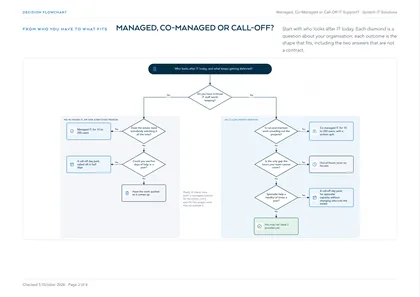
Three ways to buy IT support from us, and the questions that decide between them: whether you have IT staff worth keeping, what keeps getting deferred, and whether the estate needs somebody watching it. The flowchart above starts with who looks after IT today.
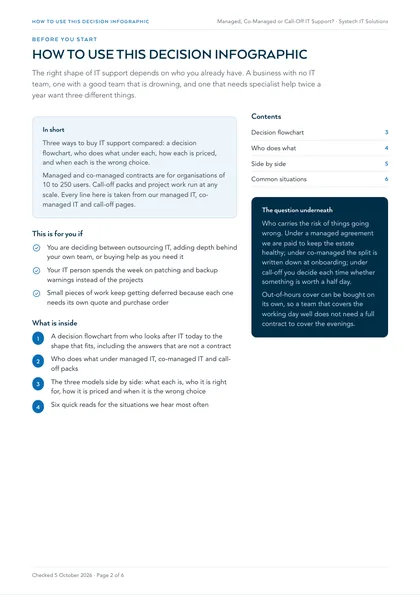
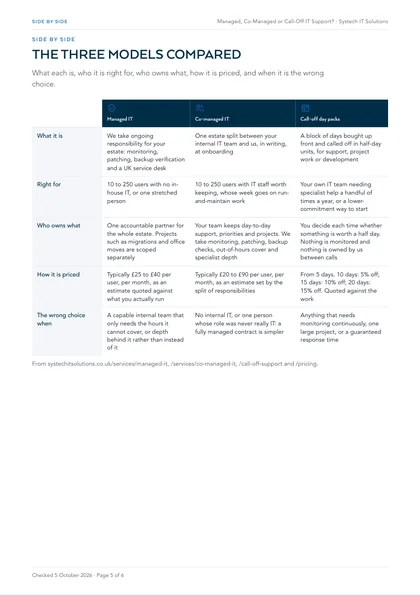
Every line here is taken from our managed IT, co-managed IT and call-off support pages. Managed and co-managed contracts are for organisations of 10 to 250 users; call-off packs and project work run at any scale.
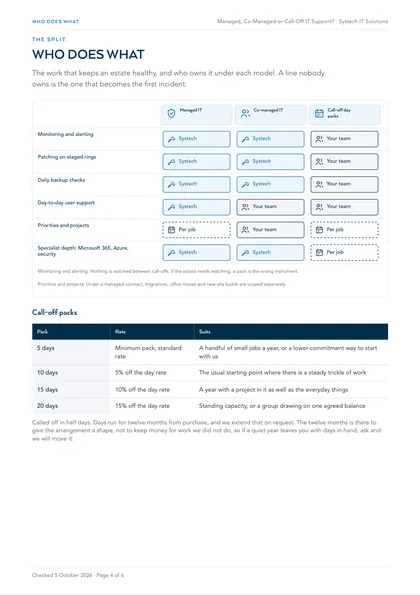
Who does what
The work that keeps an estate healthy, and who owns it under each model. A line nobody owns is the one that becomes the first incident.
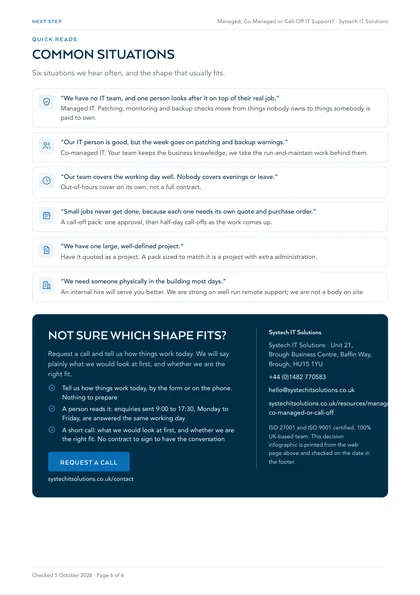
Quick reads for common situations
“We have no IT team, and one person looks after it on top of their real job.”
Managed IT. Patching, monitoring and backup checks move from things nobody owns to things somebody is paid to own.
“Our IT person is good, but the week goes on patching and backup warnings.”
Co-managed IT. Your team keeps the business knowledge; we take the run-and-maintain work behind them.
“Our team covers the working day well. Nobody covers evenings or leave.”
Out-of-hours cover on its own, not a full contract.
“Small jobs never get done, because each one needs its own quote and purchase order.”
A call-off pack: one approval, then half-day call-offs as the work comes up.
“We have one large, well-defined project.”
Have it quoted as a project. A pack sized to match it is a project with extra administration.
“We need someone physically in the building most days.”
An internal hire will serve you better. We are strong on well-run remote support; we are not a body on site.
Where this leaves you
Plenty of clients have more than one: a managed contract for the estate, and a pack for the project work that sits outside it. If you are not sure which shape fits, request a call and tell us how things work today. We will say plainly what we would look at first, and whether we are the right fit. For the split itself, the co-managed IT responsibility matrix is a ready-to-edit version, and what managed IT costs sets out what sits inside the figure.
Frequently asked
What is the difference between managed and co-managed IT?
Under managed IT we take ongoing responsibility for the estate: monitoring, patching, backup verification and a UK service desk. Under co-managed IT the estate is split between your internal team and us, in writing, at onboarding: your people keep day-to-day support, priorities and projects, and we take monitoring, patching, backup checks, out-of-hours cover and specialist depth. Both are for organisations of 10 to 250 users.
How is a call-off pack different from a managed contract?
A managed contract is continuous: we run the estate and monitor it, at a predictable cost per user per month. A call-off pack is discontinuous by design: you buy days up front, call them off in half days, and nothing is monitored or owned by us between calls. Plenty of clients have both.