
This is for you if
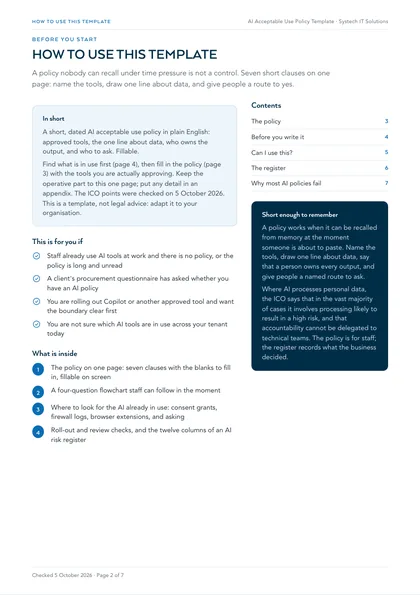
- Staff already use AI tools at work and there is no policy, or the policy is long and unread
- A client's procurement questionnaire has asked whether you have an AI policy
- You are rolling out Copilot or another approved tool and want the boundary clear first
- You are not sure which AI tools are in use across your tenant today
Most AI policies fail for three reasons: they ban a category rather than naming a tool, they are written for an auditor rather than to be followed, and they have no route to yes. The work still needs doing, so it moves to personal devices and out of sight. A short policy with named tools and a named person to ask keeps it where you can see it.
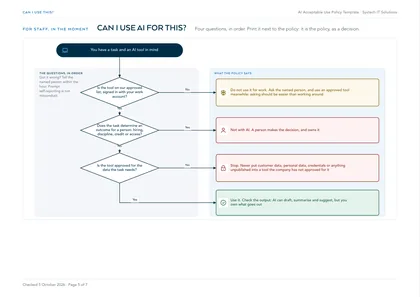
Fill in the seven clauses below, date the page, and put it where people will see it. Then use the flowchart and the checks to find the AI already in use, roll the policy out and keep it current.
It is built from our posts on writing an AI use policy people will follow, finding shadow AI in your business and the AI risk register. Find what is already in use before you fill it in, so the approved list names the tools people actually need. This is a template, not legal advice: adapt it to your organisation.
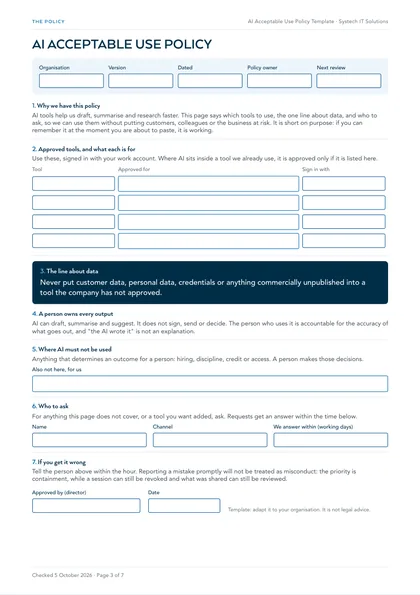
The policy
Fill in the blanks, date it, and put the version number where people can see it. The PDF version can be typed into on screen.
1. Why we have this policy
AI tools help us draft, summarise and research faster. This page says which tools to use, the one line about data, and who to ask, so we can use them without putting customers, colleagues or the business at risk. It is short on purpose: if you can remember it at the moment you are about to paste, it is working.
2. Approved tools, and what each is for
Use these, signed in with your work account. Where AI sits inside a tool we already use, it is approved only if it is listed here.
Tool Approved for Sign in with e.g. the AI assistant in your office suite e.g. drafting and summarising internal documents e.g. work account only 3. The line about data
Never put customer data, personal data, credentials or anything commercially unpublished into a tool the company has not approved.
4. A person owns every output
AI can draft, summarise and suggest. It does not sign, send or decide. The person who uses it is accountable for the accuracy of what goes out, and "the AI wrote it" is not an explanation.
5. Where AI must not be used
Anything that determines an outcome for a person: hiring, discipline, credit or access. A person makes those decisions.
Also not here, for us6. Who to ask
For anything this page does not cover, or a tool you want added, ask. Requests get an answer within the time below.
NameChannelWe answer within (working days)7. If you get it wrong
Tell the person above within the hour. Reporting a mistake promptly will not be treated as misconduct: the priority is containment, while a session can still be revoked and what was shared can still be reviewed.
Template: adapt it to your organisation. It is not legal advice.
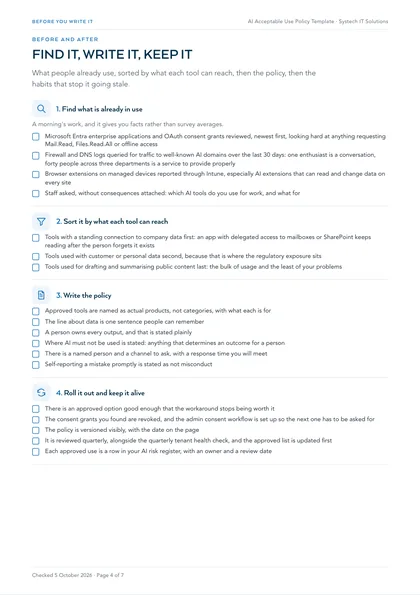
1. Find what is already in use
A morning's work, and it gives you facts rather than survey averages.
- Microsoft Entra enterprise applications and OAuth consent grants reviewed, newest first, looking hard at anything requesting Mail.Read, Files.Read.All or offline access
- Firewall and DNS logs queried for traffic to well-known AI domains over the last 30 days: one enthusiast is a conversation, forty people across three departments is a service to provide properly
- Browser extensions on managed devices reported through Intune, especially AI extensions that can read and change data on every site
- Staff asked, without consequences attached: which AI tools do you use for work, and what for
2. Sort it by what each tool can reach
- Tools with a standing connection to company data first: an app with delegated access to mailboxes or SharePoint keeps reading after the person forgets it exists
- Tools used with customer or personal data second, because that is where the regulatory exposure sits
- Tools used for drafting and summarising public content last: the bulk of usage and the least of your problems
3. Write the policy
- Approved tools are named as actual products, not categories, with what each is for
- The line about data is one sentence people can remember
- A person owns every output, and that is stated plainly
- Where AI must not be used is stated: anything that determines an outcome for a person
- There is a named person and a channel to ask, with a response time you will meet
- Self-reporting a mistake promptly is stated as not misconduct
4. Roll it out and keep it alive
- There is an approved option good enough that the workaround stops being worth it
- The consent grants you found are revoked, and the admin consent workflow is set up so the next one has to be asked for
- The policy is versioned visibly, with the date on the page
- It is reviewed quarterly, alongside the quarterly tenant health check, and the approved list is updated first
- Each approved use is a row in your AI risk register, with an owner and a review date
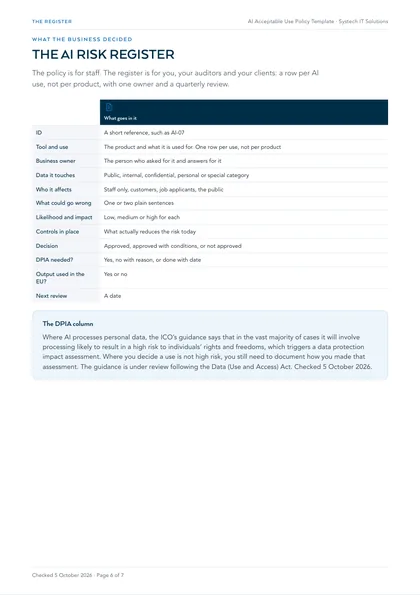
| What goes in it | |
|---|---|
| ID | A short reference, such as AI-07 |
| Tool and use | The product and what it is used for. One row per use, not per product |
| Business owner | The person who asked for it and answers for it |
| Data it touches | Public, internal, confidential, personal or special category |
| Who it affects | Staff only, customers, job applicants, the public |
| What could go wrong | One or two plain sentences |
| Likelihood and impact | Low, medium or high for each |
| Controls in place | What actually reduces the risk today |
| Decision | Approved, approved with conditions, or not approved |
| DPIA needed? | Yes, no with reason, or done with date |
| Output used in the EU? | Yes or no |
| Next review | A date |
Where personal data is involved
The ICO's guidance on AI and data protection says that in the vast majority of cases the use of AI will involve processing likely to result in a high risk to individuals' rights and freedoms, which triggers a data protection impact assessment, and that senior management cannot delegate these issues to technical teams. Where you decide a use is not high risk, you still need to document how you made that assessment. The guidance is under review following the Data (Use and Access) Act. Checked 5 October 2026.
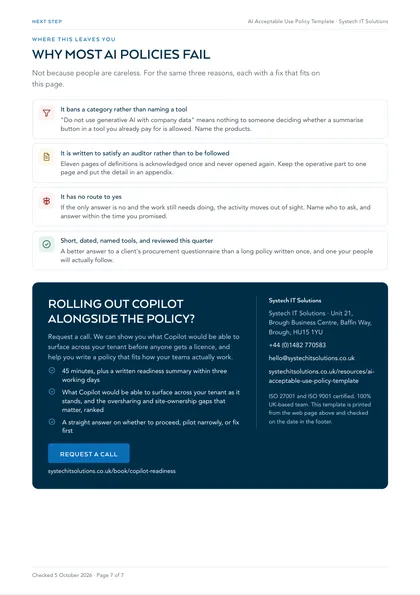
Why most AI policies fail
Not because people are careless. For the same three reasons, each with a fix.
It bans a category rather than naming a tool
"Do not use generative AI with company data" means nothing to someone deciding whether a summarise button in a tool you already pay for is allowed. Name the products.
It is written to satisfy an auditor rather than to be followed
Eleven pages of definitions is acknowledged once and never opened again. Keep the operative part to one page and put the detail in an appendix.
It has no route to yes
If the only answer is no and the work still needs doing, the activity moves out of sight. Name who to ask, and answer within the time you promised.
Short, dated, named tools, and reviewed this quarter
A better answer to a client's procurement questionnaire than a long policy written once, and one your people will actually follow.
If you are rolling out Copilot alongside the policy, our Copilot readiness check shows what it would be able to surface across your tenant before anyone gets a licence. The rest of our checklists and templates are listed on all our resources.
Frequently asked
What should an AI acceptable use policy include?
Five things change behaviour: the approved tools by name and what each is for; one line about data, such as never putting customer data, personal data, credentials or anything commercially unpublished into a tool the company has not approved; that a person owns every output; where AI must not be used, usually anything that determines an outcome for a person; and a named person and channel to ask, with a response time you will meet.
How long should an AI policy be?
Short enough to remember: the operative part on one page, with any detail in an appendix. If it cannot be recalled at the moment someone is about to paste, it is not doing any work.
How often should we review the AI policy?
Quarterly rather than annually, because tools change and AI features appear inside products you already own. Most reviews only need the approved list updated, which makes it a short job. Version it visibly so people can see it has been touched recently.
Do we need a DPIA for AI tools?
Often, where personal data is involved. The ICO's guidance says that in the vast majority of cases the use of AI will involve processing likely to result in a high risk to individuals' rights and freedoms, and that where you assess a use is not high risk you still need to document how you made that assessment. The guidance is under review following the Data (Use and Access) Act. Checked against ico.org.uk on 5 October 2026.