
In short: How a continuous cost-optimisation programme recovered around a third of a client's Azure spend, funded from waste rather than capacity.
The challenge
The client's Azure bill had crept up steadily as projects came and went, with no single owner. Oversized VMs, orphaned disks, idle non-production environments and unassigned Microsoft 365 licences had accumulated over more than a year, and a renewal was forcing the conversation.
Azure bills rarely drift for one dramatic reason. They drift because creating a resource takes a minute and removing one is nobody's job. Non-production environments get built at production sizes and then run around the clock. A project ends, its disks stay. Licences follow leavers out of the door on the org chart but not on the invoice. Because no single person sees the whole bill, each individual line looks too small to challenge, and the total only gets attention when a renewal forces it.
What we did
- Ran a full estate assessment across compute, storage and licensing to baseline real utilisation
- Right-sized oversized VMs and removed orphaned disks and idle test environments
- Applied reserved instances and a savings-plan strategy to steady-state workloads
- Reclaimed unassigned and over-specified Microsoft 365 licences
- Put continuous monitoring and board-ready monthly reporting in place so savings stick
Baseline what is actually being used
Nothing gets changed until real utilisation is measured across compute, storage and licensing, over a period rather than at a single point in time. A VM that looks busy at 10am on a Tuesday may be idle for the other 160 hours in the week. This stage is what makes every later change defensible: the argument stops being an opinion about sizing and becomes a number.
Right-size and remove the dead weight
Oversized VMs come down to the size the usage data supports. Orphaned disks, which keep billing long after the VM they belonged to has gone, get removed. Idle non-production environments are either scheduled to shut down outside working hours or decommissioned. This is the least glamorous stage and usually the largest single saving.
Commit the steady state, but only after right-sizing
Reserved instances and savings plans are applied to workloads that have proven they run continuously at a known size. Order matters here: committing to a one or three year term against an oversized VM locks the waste in rather than removing it, and it is one of the most common ways a cost-optimisation exercise ends up saving far less than it should.
Reclaim the licence estate alongside the infrastructure
Unassigned and over-specified Microsoft 365 licences are reviewed in the same pass. Licence waste behaves differently from infrastructure waste, it accumulates through joiners and leavers rather than through architecture, so it needs a different check, but it lands on the same bill and is usually quicker to recover.
Make the saving stick
Continuous monitoring and board-ready monthly reporting replace the one-off exercise. Without this stage the estate simply drifts back: new resources appear, nobody removes them, and within a year the savings have quietly eroded. The reporting matters as much as the monitoring, because a number a finance director can read is what keeps the discipline funded.
The results
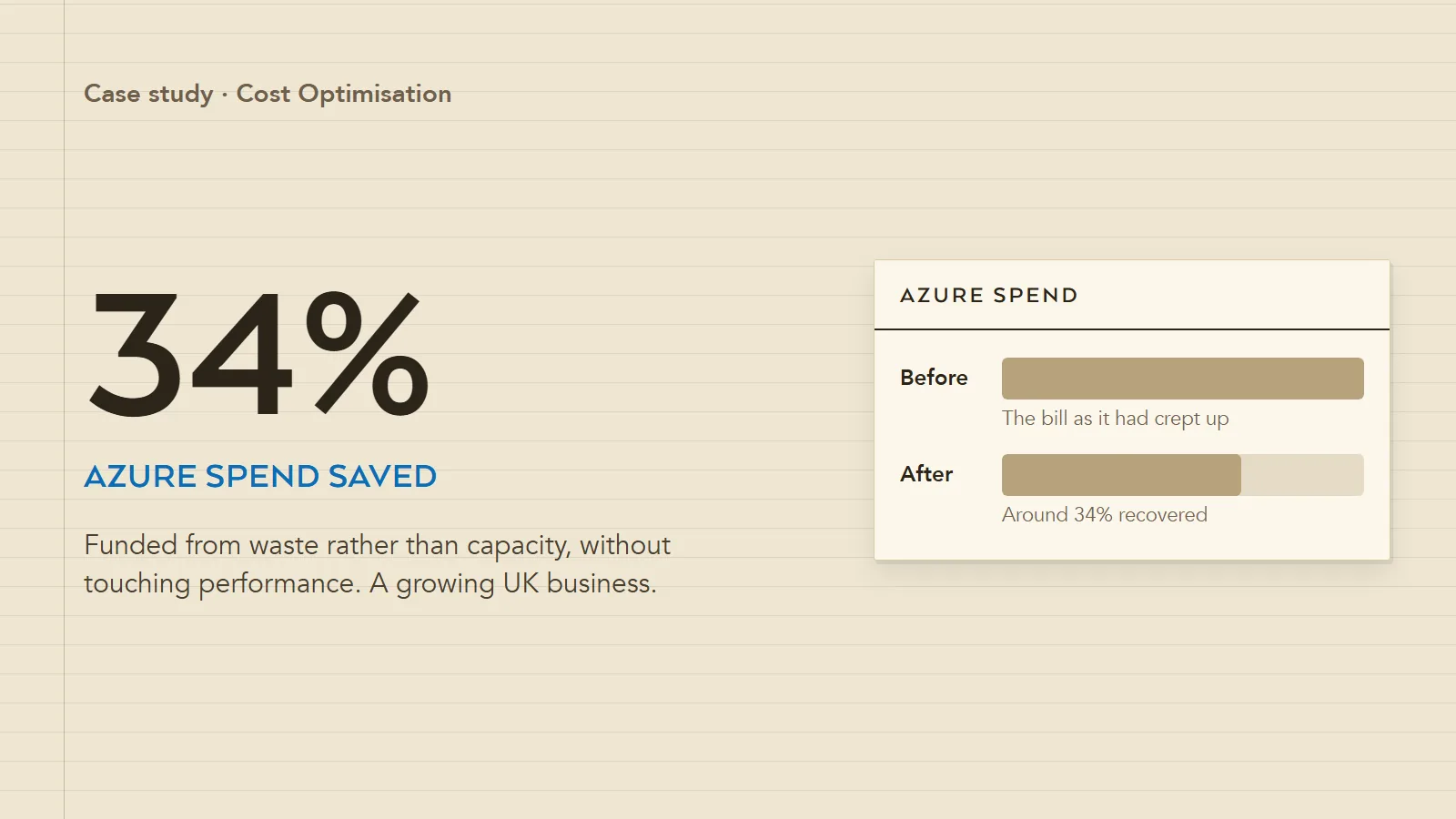
- Around 34% of Azure spend recovered
- No impact on application performance, every change was based on real usage data
- A repeatable monthly cost discipline replaced the annual renewal panic
Around 34% of Azure spend was recovered, and because every change was driven by measured utilisation rather than guesswork, none of it came at the cost of application performance. The more durable outcome is the change in rhythm: a repeatable monthly cost discipline replaced the annual scramble at renewal.
What we would tell you before you start
Right-size before you commit
The sequence is the single highest-value decision in a cost programme. Reservations bought against un-right-sized infrastructure lock in the overspend for the length of the term.
Savings decay without an owner
A cost exercise with no monthly routine behind it is a one-off discount, not a change in cost. The estate will drift back, and the second clean-up is rarely cheaper than the first.