
In short: How Systech gave a client full visibility of its Azure billing and Microsoft licence estate, turning a confusing bill into quantified, actionable spend.
The challenge
The client couldn't clearly quantify what it was spending on Azure or on its various Microsoft licence and subscription services. The bill was opaque, with no breakdown by service, workload or owner, which made it impossible to plan or challenge the cost.
A cloud bill is not designed to explain itself. It reports what was consumed, not what it was for, and it arrives grouped by meter rather than by the workload or the team that caused it. Add a Microsoft licence estate that has grown through renewals, joiners and leavers, and the result is a total that cannot be challenged in any useful way. Nobody can defend a line they cannot attribute, so the conversation stalls at the total and the waste inside it stays invisible.
What we did
- Mapped and quantified the Azure billing across services, resource groups and workloads
- Reviewed the full Microsoft licence and subscription estate
- Attributed spend to workloads and owners so every line had a why
- Produced clear, board-ready reporting the client could actually act on
- Flagged the waste and licence sprawl to tackle next
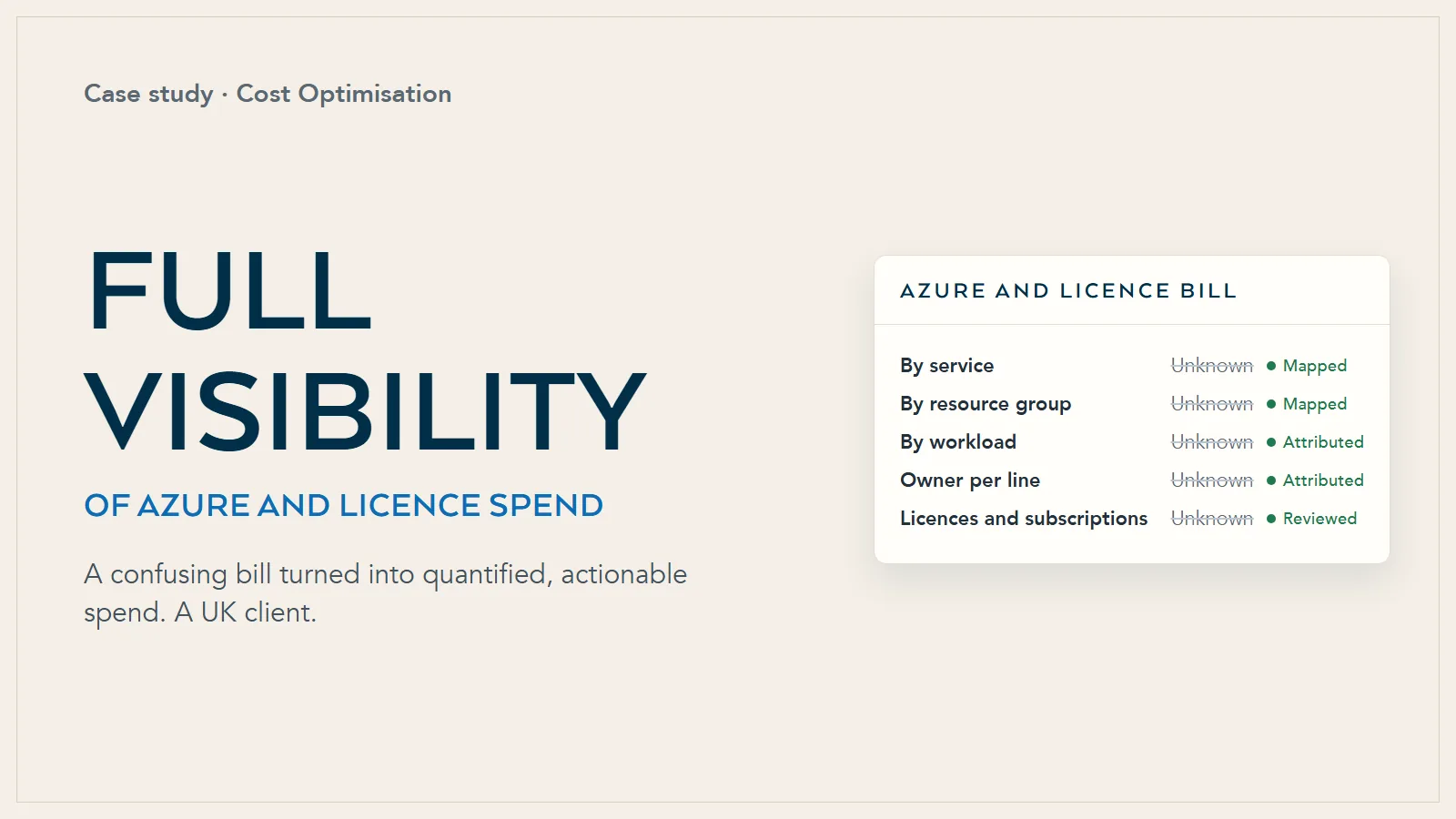
Map the billing to something recognisable
Azure billing was quantified across services, resource groups and workloads, so the bill could be read in the same terms the business uses to describe itself. This is the step that turns a meter-level invoice into something a non-specialist can interrogate.
Review the whole licence and subscription estate
The full Microsoft licence and subscription position was reviewed alongside the infrastructure. Licensing and consumption are usually treated as separate conversations because they arrive through different channels, but they land on the same budget and the waste in each is often the mirror of the other.
Attribute every line to an owner
Spend was attributed to workloads and owners, so every line had a why and a who. Attribution is what makes cost governance possible at all: an unattributed cost has no one who can approve removing it, which is precisely why it survives year after year.
Report it so it can actually be acted on
Clear, board-ready reporting replaced the raw billing export. The test applied is simple, whether someone outside IT can read the report, understand where the money is going and ask a sensible question about it.
Point at what to tackle next
The waste and licence sprawl were flagged as a prioritised next step rather than acted on in the same pass. Separating visibility from remediation keeps the first piece of work honest, the numbers are not being produced by the same exercise that is judged on reducing them.
The results
- Full visibility of Azure and licence spend for the first time
- A clear breakdown by service and workload, not one unexplained total
- A firm foundation for right-sizing and ongoing cost control
The client had full visibility of Azure and licence spend for the first time, expressed as a clear breakdown by service and workload rather than one unexplained total. That visibility is the foundation the later right-sizing and ongoing cost control were built on, none of which is possible while the bill remains opaque.
What we would tell you before you start
Visibility comes before savings
Cost-cutting against a bill nobody understands is guesswork, and guesswork in an Azure estate tends to remove the wrong thing. Map it first.
Attribution is the control, not the report
The value is not the document. It is that every line now has an owner who can be asked whether it is still needed.