
This is for you if
- Your firewall was configured once, by someone who may not even work there anymore
- Nobody could tell you the last time firmware or rules were reviewed
- You want protection that's actually monitored, not just installed
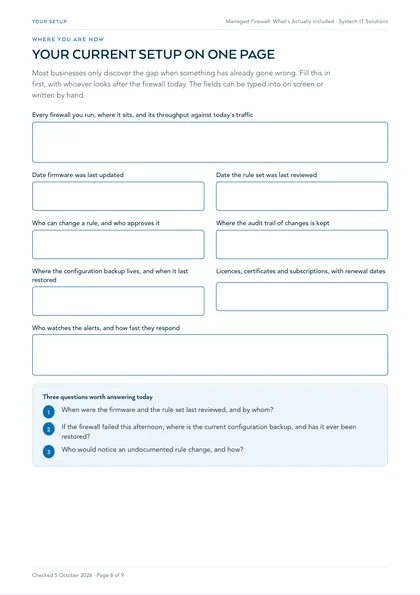
DIY firewall management looks cheaper right up until a missed patch, an undetected rule change, or configuration drift turns into a network-down incident, at which point the savings evaporate in downtime and emergency support. Most businesses only discover the gap when something has already gone wrong.
"Managed firewall" means different things from different providers, some of it is little more than a box shipped once and left alone. Here's exactly what a properly managed firewall service covers, end to end, so you can see what a DIY setup, or a thinner managed offering, actually isn't giving you.
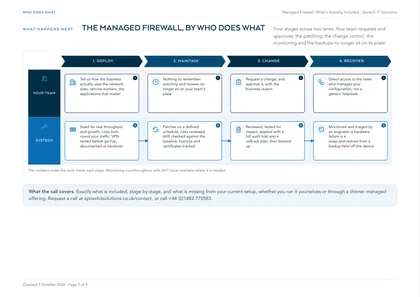
This isn't only for businesses without an IT team. A lot of our managed firewall clients have their own in-house team already; they just don't want firewall change control, patch scheduling and alert triage sitting on that team's plate specifically. We take the firewall estate off your hands as a defined, standalone service, and your team keeps everything else.
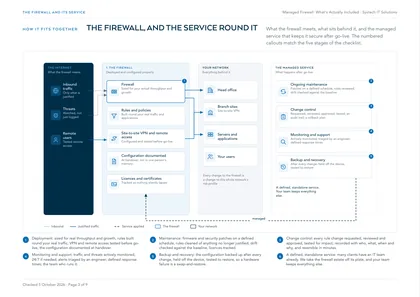
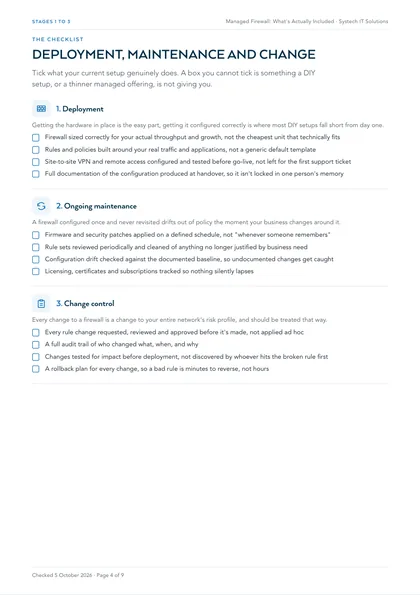
1. Deployment
Getting the hardware in place is the easy part, getting it configured correctly is where most DIY setups fall short from day one.
- Firewall sized correctly for your actual throughput and growth, not the cheapest unit that technically fits
- Rules and policies built around your real traffic and applications, not a generic default template
- Site-to-site VPN and remote access configured and tested before go-live, not left for the first support ticket
- Full documentation of the configuration produced at handover, so it isn't locked in one person's memory
2. Ongoing maintenance
A firewall configured once and never revisited drifts out of policy the moment your business changes around it.
- Firmware and security patches applied on a defined schedule, not "whenever someone remembers"
- Rule sets reviewed periodically and cleaned of anything no longer justified by business need
- Configuration drift checked against the documented baseline, so undocumented changes get caught
- Licensing, certificates and subscriptions tracked so nothing silently lapses
3. Change control
Every change to a firewall is a change to your entire network's risk profile, and should be treated that way.
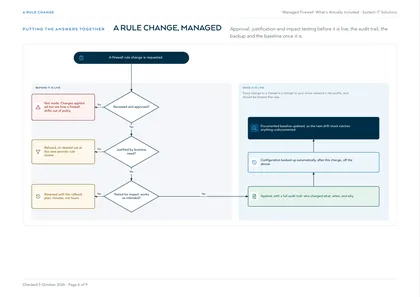
- Every rule change requested, reviewed and approved before it's made, not applied ad hoc
- A full audit trail of who changed what, when, and why
- Changes tested for impact before deployment, not discovered by whoever hits the broken rule first
- A rollback plan for every change, so a bad rule is minutes to reverse, not hours
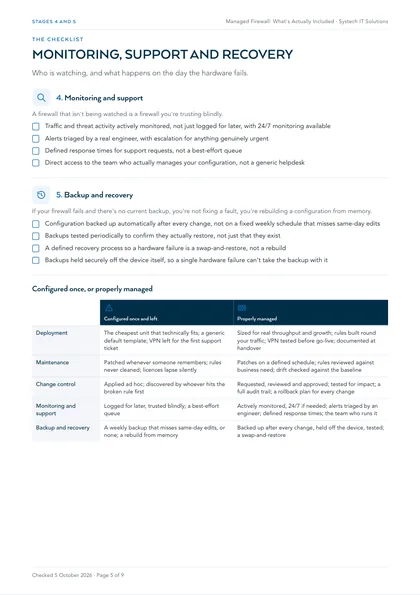
4. Monitoring and support
A firewall that isn't being watched is a firewall you're trusting blindly.
- Traffic and threat activity actively monitored, not just logged for later, with 24/7 monitoring available
- Alerts triaged by a real engineer, with escalation for anything genuinely urgent
- Defined response times for support requests, not a best-effort queue
- Direct access to the team who actually manages your configuration, not a generic helpdesk
5. Backup and recovery
If your firewall fails and there's no current backup, you're not fixing a fault, you're rebuilding a configuration from memory.
- Configuration backed up automatically after every change, not on a fixed weekly schedule that misses same-day edits
- Backups tested periodically to confirm they actually restore, not just that they exist
- A defined recovery process so a hardware failure is a swap-and-restore, not a rebuild
- Backups held securely off the device itself, so a single hardware failure can't take the backup with it
| Configured once and left | Properly managed | |
|---|---|---|
| Deployment | The cheapest unit that technically fits; a generic default template; VPN left for the first support ticket | Sized for real throughput and growth; rules built round your traffic; VPN tested before go-live; documented at handover |
| Maintenance | Patched whenever someone remembers; rules never cleaned; licences lapse silently | Patches on a defined schedule; rules reviewed against business need; drift checked against the baseline |
| Change control | Applied ad hoc; discovered by whoever hits the broken rule first | Requested, reviewed and approved; tested for impact; a full audit trail; a rollback plan for every change |
| Monitoring and support | Logged for later, trusted blindly; a best-effort queue | Actively monitored, 24/7 if needed; alerts triaged by an engineer; defined response times; the team who runs it |
| Backup and recovery | A weekly backup that misses same-day edits, or none; a rebuild from memory | Backed up after every change, held off the device, tested; a swap-and-restore |
Where this leaves you
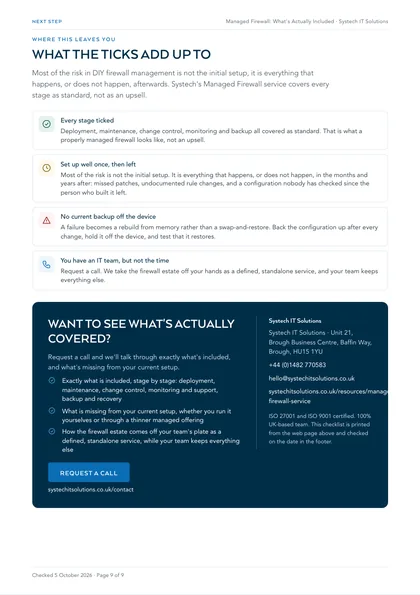
Most of the risk in "DIY firewall management" isn't the initial setup, it's everything that happens, or doesn't happen, in the months and years after. Missed patches, undocumented rule changes, and a configuration nobody's checked since the person who built it left are what turn a firewall from protection into a liability. Systech's Managed Firewall service covers every stage above as standard, not as an upsell.
Every stage ticked
Deployment, maintenance, change control, monitoring and backup all covered as standard. That is what a properly managed firewall looks like, not an upsell.
Set up well once, then left
Most of the risk is not the initial setup. It is everything that happens, or does not happen, in the months and years after: missed patches, undocumented rule changes, and a configuration nobody has checked since the person who built it left.
No current backup off the device
A failure becomes a rebuild from memory rather than a swap-and-restore. Back the configuration up after every change, hold it off the device, and test that it restores.
You have an IT team, but not the time
Request a call. We take the firewall estate off your hands as a defined, standalone service, and your team keeps everything else.
This is one of a set. The rest, covering AI readiness, security, cost, compliance and device management in the same format, are listed on all our free checklists and assessments.