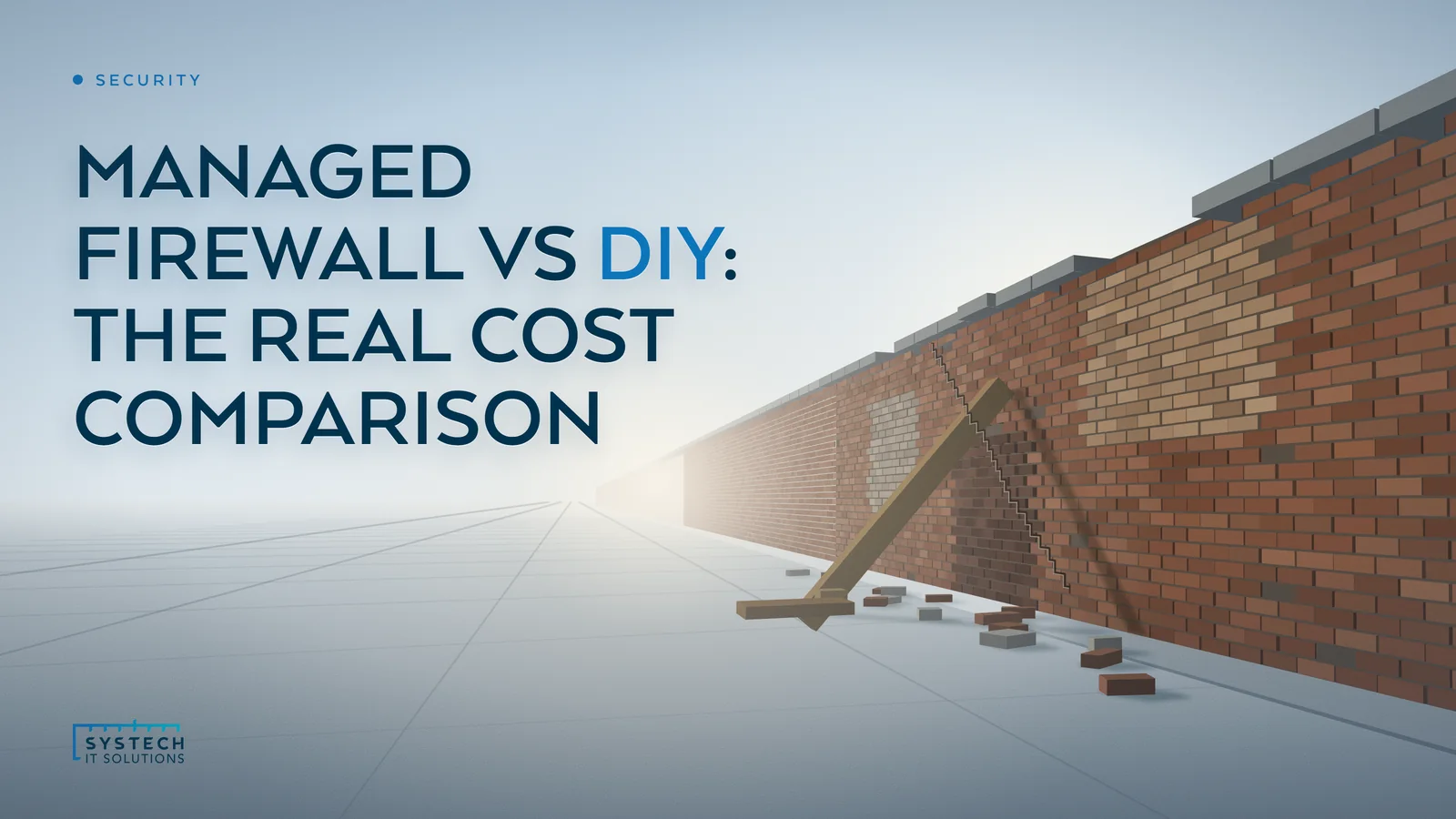
Every business with a firewall has, at some point, asked whether it really needs to pay someone else to manage it. The device works. Someone on the team can log in and change a rule when needed. Why pay for more than that? The honest answer is that the licence and the hardware were never the expensive part.
In short: DIY firewall management looks cheaper because the appliance and its licence are the only costs you can see. The expensive part is running it well, day after day: proactive firmware patching, configuration backup, log monitoring and out-of-hours cover. A managed service usually works out cheaper the moment firewall upkeep becomes nobody's clearly-owned job, which is what happens as a network grows.
What's the firewall cost you can see?
Run the numbers on DIY and they look straightforward. You've bought the appliance, you're paying the annual licence, and the person who set it up can still find their way around the admin console. Compared to a monthly managed service fee, self-managing looks like the cheaper option, sometimes considerably so, and for a business watching every line of the IT budget, that's a reasonable place to start.
The trouble is that this comparison only counts the cost of owning the box. It says nothing about the cost of running it well, day after day, for years. That's where the real difference between DIY and managed sits, and it's almost entirely invisible until something goes wrong.
What's the cost you don't see until it bites?
A firewall isn't a device you configure once and leave alone. It needs attention every week, and in most SMBs that attention falls to whoever on the IT team has the least full plate that day. That's the first hidden cost: a generalist has to context-switch into firewall specialism, work out what's changed since they last logged in, and hope they don't miss anything. It's rarely anyone's full-time job, so it's rarely done with the depth it deserves.
Patching
Patching is where this shows up first. Firmware updates fix real vulnerabilities, and vendors don't release them for fun. But when nobody owns the patching cycle, updates get deferred "until things are quieter," which in practice means they slip for weeks or months. A firewall running old firmware isn't a cost saving, it's a known door left ajar.
Configuration backup
Configuration backup catches people out hardest. Rules accumulate over years: a temporary exception for a supplier that was never removed, a port opened for a project long finished, tweaks made by people who've since left. None of that lives anywhere except on the appliance itself. If that hardware fails, and appliances do fail, recovery isn't a restore, it's a rebuild from memory, under pressure, while the business is offline.

The real cost of DIY firewall management isn't the time it takes when everything's working. It's the outage, or the breach, that happens on the one week nobody was watching.
Watching the logs
And that's the last piece: watching. Firewalls generate logs constantly, and buried in that noise are the early signs of a misconfigured rule, a brute-force attempt, or traffic that doesn't look right. Reading those logs properly, every day, takes discipline that's hard to sustain against helpdesk tickets and everything else on a generalist's list. Most DIY setups have no one watching in the gaps, evenings, weekends, the 2am patch window, which is exactly when problems tend to surface.
DIY vs managed firewall: where the cost really sits
| DIY firewall | Managed firewall service | |
|---|---|---|
| Visible cost | Appliance plus annual licence | Predictable monthly fee |
| Firmware patching | Deferred, rarely clearly owned | Proactive, on an owned schedule |
| Configuration backup | Lives on the box only | Automated and restorable |
| Log monitoring | Ad hoc, business hours at best | Continuous, 24/7 |
| Out-of-hours cover | None | Included |
| Recovery after hardware failure | Rebuild from memory, under pressure | Restore from backup |
| Best fit | Very small, single-site, with a genuine owner | Growing or multi-site networks |
What should a genuinely managed firewall service include?
Not every "managed firewall" offering earns the name. Before you pay for one, it's worth checking it actually covers the gaps above, rather than just remote access to the same console you already have:
- 24/7 monitoring, not business-hours-only, so an issue at 2am gets picked up when it happens rather than when someone next logs in
- Automated configuration backup, so a hardware failure is a straightforward restore rather than a rebuild from memory
- Proactive patching and firmware management, on a schedule someone owns, rather than deferred until it's convenient
- Monthly reporting you can actually read, covering traffic, threats and compliance in plain terms, not a raw log dump nobody has time to interpret
This is the gap our own Managed Firewall service was built to close. We developed the monitoring and backup platform in-house rather than reselling a generic third-party product, specifically so alerting, reporting and escalation can be tailored to how a business actually wants to be told about a problem, instead of a bloated tool you'll only ever use a fraction of.

So is DIY firewall management ever the right call?
None of this means DIY is always the wrong call. A very small business with a simple, single-site network and an IT person who genuinely has the time and specialism to own the firewall properly, patching promptly, backing up configuration, watching logs, can manage perfectly well without a third party. The saving is real and the risk is manageable if that ownership is genuine rather than assumed.
What tends to happen as a business grows, though, is that the network gets more complex, the generalist's time gets pulled in more directions, and firewall management quietly slides from "someone's job" to "no one's job." That's the threshold to watch for. Once it's crossed, the hidden cost of DIY, in patching lag, unrecovered config, and alerts nobody saw, stops being a rounding error and starts outweighing a managed service fee. The licence was never the expensive part. The gap in attention is.
It's the same trade-off businesses face for IT support as a whole, not just the firewall. If you're weighing that bigger decision, our managed IT vs in-house vs break-fix comparison breaks down the same hidden-cost dynamic across the full IT estate.
Frequently asked
Is a managed firewall cheaper than managing it yourself?
Usually, once firewall upkeep stops being anyone's clearly-owned job, which is what happens as a network grows. DIY looks cheaper because the appliance and its licence are the only costs you can see. The expensive part is running it well: patching, configuration backup, log monitoring and out-of-hours cover.
What are the hidden costs of managing a firewall yourself?
A generalist context-switching into firewall specialism; firmware patching deferred until things are quieter; configuration that exists only on the appliance, so a hardware failure means rebuilding rules from memory rather than restoring them; and logs nobody reads in the evenings, weekends and the 2am patch window.
What should a genuinely managed firewall service include?
24/7 monitoring rather than business hours only, automated configuration backup so hardware failure is a restore rather than a rebuild, proactive patching and firmware management on a schedule someone owns, and monthly reporting in plain terms covering traffic, threats and compliance instead of a raw log dump.
Is DIY firewall management ever the right call?
Yes. A very small business with a simple, single-site network and an IT person who genuinely has the time and specialism to own the firewall properly, patching promptly, backing up configuration and watching logs, can manage perfectly well without a third party. The saving is real where that ownership is genuine rather than assumed.